 Most viewed Most viewed |
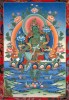
01_tara.jpgThe 21 Taras (01)5987 viewsThe 21 Taras [Tibetan style] (Tibetan, Sgrol-ma)
It was not until the adoption of the Yogachara system, taught by Asanga in the fourth century AD, that the feminine principle began to be venerated in Mahayana Buddhism. Around the sixth century, the goddess Tara was considered as a Sakti of Avalokitesvara (sometimes as his wife).
|
|

02-chant-02.mp3Buddhabhivadana - Salutation to the Buddha5982 viewsVandana: Pali Devotional Chanting
Track No. 02
Compiled and recited by Venerable Indaratana Maha Thera
|
|

knot02.jpgSacred Knot025966 viewsTibetan Buddhist Art Work: Sacred Knot02
|
|

knot04.jpgSacred Knot045919 viewsTibetan Buddhist Art Work: Sacred Knot04
|
|
livngmed.pdfLiving Meditation, Living Insight5888 viewsI wrote this book to encourage practitioners learning to meditate in daily life. In this sense, the articles are presented as a hands-on or, more accurately, a minds-on training manual. Although I discuss meditation in general, the real focus is on how the Dhamma brings us into spontaneous, wholesome and creative living. My objective in presenting the articles is to help the aspirant build up a solid foundation of mindfulness as a way of life rather than as a practice separated from daily living - Dr. Thynn Thynn.
|
|

artliv12.pdf5869 views
|
|
ratana.mp3Ratana Sutta5849 viewsThe Jewel Discourse.
Ratana Sutta - The Jewel Discourse.
|
|

buddha_life_02.gifQueen Mahamaya's Dream5833 viewsQueen Mahamaya's Dream
|
|

appropriate_response.flvAn Appropriate Response5831 viewsGil Fronsdal is the primary teacher for the Insight Meditation Center in Redwood City, California; he has been teaching since 1990. He has practiced Zen and Vipassana in the U.S. and Asia since 1975. He was a Theravada monk in Burma in 1985, and in 1989 began training with Jack Kornfield to be a Vipassana teacher. Gil teaches at Spirit Rock Meditation Center where he is part of its Teachers Council.
|
|
chandew.pdfThe Sweet Dews of Ch'an5825 viewsReverend Cheng Kuan
Ch'an or Zen is the outcome of meditation. There are two 'right'or 'highest' purposes of Ch'an. The first purpose is to achieve Dhyana. Dhyana is a combination of relaxation, concentration and calmness or tranquility. The second purpose is, using your very composed and tranquil mind, to observe clearly all the dharmas or phenomena externally and internally. As an outcome of Dhyana, you will be able to observe these phenomena very clearly because your mental mirror is very clear, for there are no more disturbances to veil it. Out of these observations will come Transcendental Wisdom, which in Sanskrit is called Prajna.
|
|
| 1212 files on 122 page(s) |
 |
|
|
10 | |
|
|
|






















 Social Bookmarks


