 Most viewed - eBook Library Most viewed - eBook Library |

seeding.pdfSeeding the Heart3889 viewsGregory Kramer
Loving-kindness Meditation with Children. The practice of loving-kindness, or metta, can be done in one of two ways: either in intensive prolonged meditation to develop deep states of concentration, or in daily life at any time one meets with people and animals or thinks about them. To learn about the radiating of metta to all beings with children, we have to tap into the store of knowledge accumulated by lay people and parents. It must be knowledge which has grown out of years of living and loving with children and young adults. Gregory Kramer, father of three boys, shows us here with what subtle but precise adjustments in the standard practice of loving-kindness he was able to anchor it in the lives of his children.
|
|
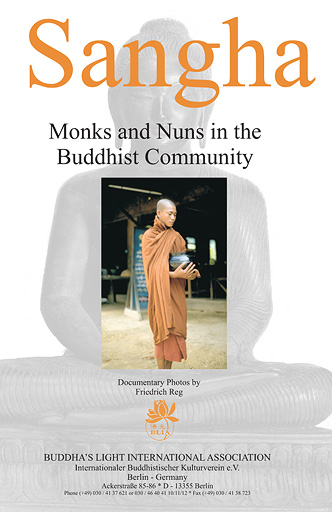
The_Sangha_-_Photos_by_Friedrich_Reg.pdfSangha - Monks and Nuns in the Buddhist Community3886 viewsDocumentary Photos by Friedrich Reg
|
|
60songs.pdfSixty Songs of Milarepa3882 viewsThe songs printed here all concern that Dharma which is common to the whole Buddhist tradition. Among the Bhikkhus living in the Buddha's time, Vangisa Thera was outstanding for his inspired utterances (see Samyutta Nik.I.viii; Theragatha 395). The mind inspired and illumined with the knowledge of liberation pours forth its wisdom with ease in the shape of verses of great beauty and deep significance. Such was the case with Lord Buddha and some of his immediate disciples, and later, such was the case with Milarepa.
|
|
rebirthscience.pdfScientific Acceptability of Rebirth3843 viewsDr. Dharmawardena points out that the reason why classical science cannot explain rebirth is due to inherent limitations in classical science. Modern science has transcended these limitations, and therefore rebirth is within the scope of modern science. Modern science accepts rebirth as a scientifically acceptable phenomenon through the same tests used to prove scientific acceptability of generally accepted modern science phenomena.
|
|
rbddh10.pdfRecord of Buddhistic Kingdoms3829 viewsFa-Hien was a Chinese monk of the Eastern dynasty (4th-5th Century). In 399 he left China for India, finally arriving there after six years of hard travel. After studying Sanskrit and obtaining many Sanskrit texts of the Tripitaka (Buddhist canon), he returned to China by sea in 414. This text is an Account by Fa-Hien of his travels in India and Ceylon (A.D. 399-414) in Search of the Buddhist Books of Discipline. Translated and annotated with a Corean recension of the Chinese text by James Legge.
|
|
mahasati.pdfMaha Satipatthana Sutta3827 viewsVen. U Jotika and Ven. U Dhamminda
Practise in accordance with this Mahasatipatthana Sutta so that you can see why it is acknowledged as the most important Sutta that the Buddha taught. Try to practise all the different sections from time to time as they are all useful, but in the beginning start with something simple such as being mindful while walking, or the mindfulness of in and out breathing. Then as you practise these you will be able to practise the other sections contained within this Sutta and you will find that all the four satipatthanas can be practised concurrently. A Sutta should be read again and again as you will tend to forget its message. The message here in this Sutta is that you should be mindful of whatever is occurring in the body and mind, whether it be good or bad, and thus you will become aware that all conditioned phenomena are impermanent, unsatisfactory and not self.
|
|
bhikkhuni_patimokkha.pdfThe Bhikkhuni Patimokkha of the Six Schools3807 viewsDr. Chatsumarn Kabilsingh has translated the monastic rules of Buddhist nuns or the Patimokkha of the Six Schools, which will help us to learn and compare Theravada, Mahasanghika, Mahisasaka, Sarvastivada, Dhamagupta and Mula-Sarvastivada. The study of the patimokkha also provides insight into the historical context from which the rules took place. This translation will also provide valuable material for concerned Buddhist scholars.
|
|
Between_The_Lines_Vol__1.pdfBetween The Lines (Volume 1) An analytical appreciation of the Buddha's Life 3807 views"Some 2500 years ago in ancient Northeast India, a young, brilliant and courageous man discovered the sublime answer to how the mind works and how to realise unconditioned happiness and bliss. For the next 45 years, he devoted his life to teaching the doctrine that helped bring unparalleled happiness, peace and relief to numerous people long after his death. In time stories began to emerge proclaiming his greatness and his near-divinity status. Over generations and into distant lands, those stories took on a life of their own. Eventually the real man is buried under a mountain of beautiful fantasies and magical tales. Scholars in Buddhist studies have never lost sight of the historical Buddha. There is a beautiful story to tell about the real man but the materials never quite made it to the mass market because academic books are generally hard to read and appreciate.
|
|
icon_nepbud.pdfThe Iconography of Nepalese Buddhism3799 viewsThis is an illustrated version of the Iconography of Nepalese Buddhism.
|
|
words_of_buddha.pdfDaily Readings from Buddha's Words of Wisdom3797 viewsVen. Shravasti Dhammika
For over two millennium the discourses of the Buddha have nourished the spiritual lives of countless millions of people in India, Sri Lanka, Burma and Thailand. This book contains extracts from some of these discourses selected from the Pali Tipitaka and also from some post-canonical writings. Rendered into readable English, presented so that one extract can be read and reflected upon each day of the year and provided with a Readers Guide, this book is an indispensable companion for anyone trying to apply the Buddha's gentle message to their daily life.
|
|
| 347 files on 35 page(s) |
 |
|
|
15 | |
|
|
|





















 Social Bookmarks


